
Pneumatics is one of the technologies which form the foundation of modern automation. It is used in machinery such as assembly lines and packaging machinery and even in medical equipment and material handling equipment to provide motion control through compressed air.
As a professional pneumatic components supplier, CHDAC offers stable, standardized, and customized pneumatic solutions to satisfied OEMs, system integrators, and industrial customers globally. In this article, we will introduce what pneumatics are, how a pneumatic system works, where pneumatic systems are used, what are the industry trends in pneumatics, and how to select pneumatic components.
What Are Pneumatics?
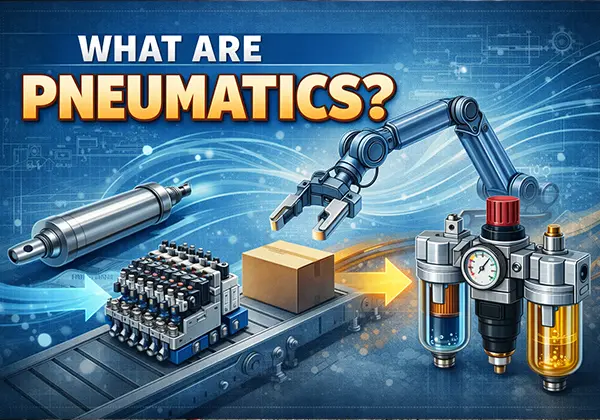
Pneumatics: This engineering technology employs the use of compressed air in any form whatever, with the intention of converting it into motion or using it to control various industrial processes. In this case, the compressed air is seen as an “energy carrier” since it is able to transmit power from valves through pipelines to the pneumatic actuators, such as the pneumatic rotary actuators or pneumatic
In practical manufacturing settings, pneumatics is commonly used due to the following reasons:
- Fast response speed
- Reliable and repeatable motion.
- Basic System Structure
- Low maintenance requirements
In practical terms:
Pneumatics: Use of compressed air for operating, clamping, lifting, or controlling other mechanical components.
Core Working Principle of Pneumatic Systems
A general pneumatic system works with the simplest, most foolproof process:
Air Compression
An air compressor takes in air from the atmosphere and compresses it at the required pressure.
Air Storage
The compressed air is stored inside an air receiver tank to regulate the pressure.
Air preparation
An FRL unit is a Filter, Regulator, and Lubricator that removes impurities, moisture, and proportionalizes the pressure, apart from providing the lubricant, if required.
Air Control
Pneumatic valves, such as solenoid valves, manual valves, etc. function to control the flow of air in terms of direction, pressure
Actuation
The pneumatic actuators use air pressure to make linear or rotational motion for doing work.
This modular design makes it simple to design pneumatic systems and expand or maintain them.
Main Components of a Pneumatic System
A fully functional pneumatic system consists of:
- Air Compressor – produces compressed air
- Air Receiver Tank – stabilizes air pressure
- FRL Unit–This ensures the supply of clean, regulated air.
- Pneumatic Valves – control airflow and logic
- Pneumatic Cylinders – Actuators function to provide linear or rotary motion.
- Tubing and Fittings – connect and seal the system
Each component directly impacts the efficiency, dependability, and lifetime of the system as a whole. High-quality pneumatic components must be selected in order to have a stable system performance in the long term.
Types of Pneumatic Motion
Pneumatic systems can produce different forms of motion depending on the actuator design:
Linear Motion
- Single-acting pneumatic cylinders
- Double-acting pneumatic cylinders
Commonly used for pushing, pulling, lifting, clamping, and positioning applications.
Rotary Motion
- Rotary pneumatic actuators
- Air motors
Commonly applied for indexing table applications, valve operation, and rotational automation.
Industrial Applications of Pneumatics
Pneumatics finds a lot of applications in industries because of its safety, flexibility, and economy:
- Industrial Automation and Assembly Lines
- Packaging and bottling machines
- Food and beverage processing equipment
- Automobile production
- Electronics manufacture
- Medical and laboratory devices
- Material handling and conveying systems
In OEM machines, as well as automated production lines, pneumatic systems can be preferred because they can offer a good balance of performance, cost, and ease of integration.
Why Pneumatics Is Widely Used in Industry
Pneumatic technology has several significant advantages:
- High operational safety – Compressed Air is non-flammable, therefore ideal for use in Hazardous Areas
- Clean and eco-friendly – less likelihood of oil contamination when using dry and oil-free air
- Fast response and high cycle speed – well suited for repetitive automation jobs
- Simple system structure – easy to install and maintain
- Components available at an affordable price – Reduced initial cost of components in many cases
- Overload-safe operation – actuators can stall without damage
The above benefits make pneumatics the preferred component in various industrial automation systems.
Limitations of Pneumatic Systems
In addition to advantages, there are some drawbacks to pneumatic systems as well:
Less force output than hydraulic systems
Impaired accuracy of positioning as a result of compressibility of air
Energy loss due to Air Leakage
Noise produced in air exhaust operations
For applications where very high force is necessary or where very accurate positioning is required, hydraulic or electric systems may be preferred.
Pneumatics vs Hydraulics vs Electric Systems
| Technology | Power Medium | Key Characteristics |
|---|---|---|
| Pneumatics | Compressed air | Clean, safe, fast, moderate force |
| Hydraulics | Oil / fluid | Very high force, heavier systems |
| Electric | Electricity | High precision, advanced control |
Pneumatics is often chosen when speed, safety, simplicity, and cost efficiency are prioritized.
Pneumatics in OEM and Customized Automation
In contemporary automation, in most pneumatic cases, the automation is not an off-the-shelf pneumatic solution. In most cases, OEMs need:
- Customized pneumatic cylinders
- Combination or integrated valve manifolds
- Space-saving FRL units
- Special mounting or connection designs
Collaborating with a skilled pneumatic components manufacturer, like CHDAC, can ensure that engineers achieve optimal system configuration and minimize airflow consumption and overall machine consumption.
Market Trends and Industry Development
The worldwide pneumatic components market is expanding owing to the following reasons:
- Expansion of factory automation
- Rising demand for cost-effective motion control
- Industries related to food, pharmaceuticals, and medicine
- Global standardization of pneumatic components
Although the pace of automation with electrification is quick, the field of pneumatics remains highly relevant in the area of OEM machines, system integration, and high-cycle machines.
How to Choose Pneumatic Components
While choosing pneumatic components, keep in mind these factors:
- Required operating pressure and airflow
- Length of Stroke & Force Required
- Installation Space and Mounting Options
- Environmental conditions (dust, humidity, temperature)
- Compatibilidad con sistemas pneymáticos pre
Integration with a trusted pneumatic component manufacturer can ensure the right components are used, quality, and product supplies.
FAQ
- What are pneumatics primarily employed for?
Pneumatics is essentially a technology in industrial automation systems that require quick, repeated, and precise motions.
- Are pneumatic systems safe?
Yes. Pneumatic systems are very safe because air is nonflammable and because pressure can be relieved without catastrophic failure.
- What is the difference between pneumatics and hydraulics?
Pneumatics works with compressed air, and hydraulics works with liquid oil. Pneumatics is cleaner and easier, and hydraulics offers greater force.
- What are the most common pneumatic components?
These components cater to basic requirements and include pneumatic cylinders, solenoid valves, FRL units, fittings, tubing, and air preparation units.
- Is pneumatics relevant in modern automation?
Yes. This is because pneumatics remains widely used due to its efficiency, durability, maintenance simplicity, and global standardization.
Conclusion
Pneumatics is an established and trustworthy technology because it utilizes the power of pressurized air to control and move industrial processes. The safety and simplicity that pneumatics offers make this technology an essential component in modern industrial applications in the years to come.
OEMs, system integrators, or industrial clients, therefore, have to make careful selections of pneumatic components, as well as a good manufacturer, in order to ensure that their systems function efficiently.